
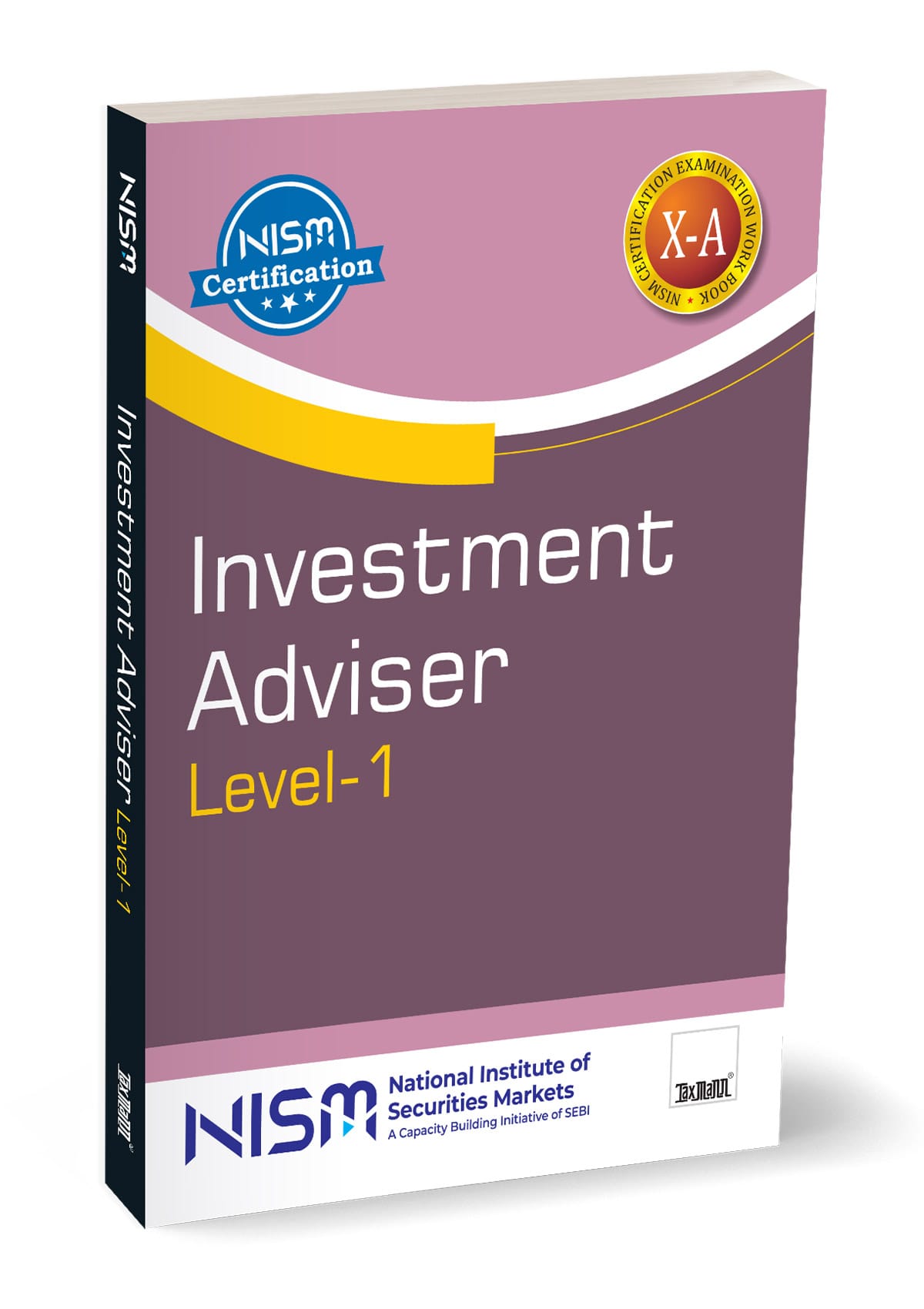
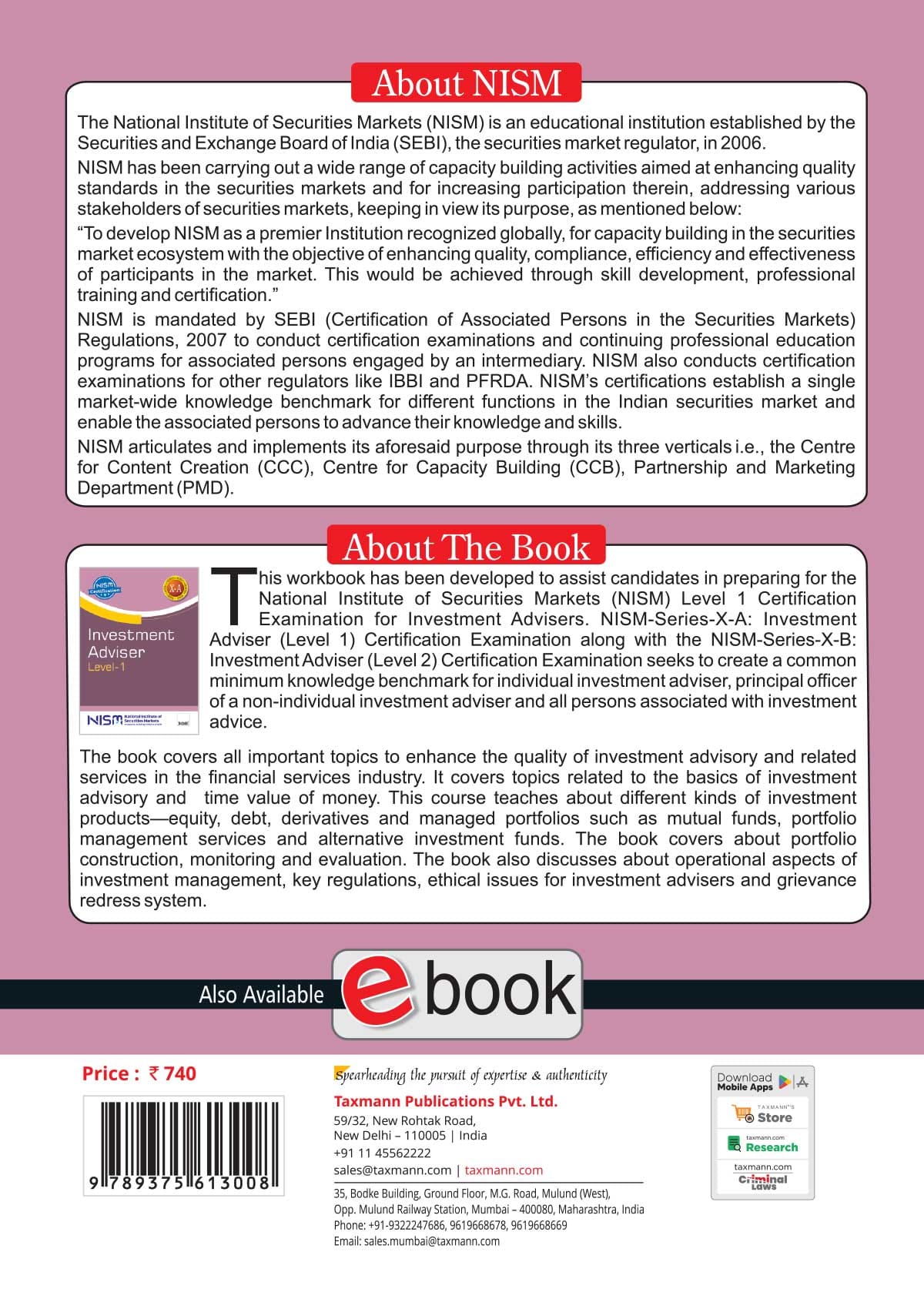
About NISM Investment Advisor Level 1 Workbook:
NISM Investment Adviser (Level 1) Workbook is designed to take the reader from first principles to practitioner-grade competence. It opens with the architecture of personal financial planning and the mathematics of money, moves through the complete menu of investment products—equity, fixed income, derivatives, and pooled and managed vehicles—and closes with portfolio construction and evaluation, the operational machinery of investing, the governing regulatory code, and the ethical and fiduciary standards that bind the profession. It assumes no prior advisory background, yet it treats valuation, bond mathematics, and portfolio theory with genuine analytical rigour, so it serves equally as an examination text and as a standing reference for the advisory desk.
This book is intended for the following audience:
- Individuals Seeking SEBI Registration as an Investment Adviser, and the principal officers of non-individual (corporate/LLP) investment advisers
- Persons Associated with Investment Advice required to be certified under the SEBI (Investment Advisers) Regulations 2013
- Candidates Preparing for the NISM-Series-X-A: Investment Adviser (Level 1) Certification Examination
- Financial Planners, Wealth Managers, Relationship Managers, and Advisory-Desk Professionals who need a regulator-defined, structured knowledge benchmark
- Students and Job Aspirants building a career in financial planning, wealth management, or securities-market advisory
- Practising Advisers and Advisory Firms using the text for Continuing Professional Education (CPE) and internal training
The Present Publication is the March 2026 Workbook Version, developed in collaboration with the NISM Certification Team and subject-matter experts—Arnav Pandya, Pratap Giri, Rachana Baid, Rama Iyer, Sunita Abraham, Sundar Sankaran, and Joydeep Sen. It is published exclusively by Taxmann, with the following noteworthy features:
- Authoritative, Peer-Reviewed Authorship: Developed by NISM’s Certification team with a panel of recognised industry subject-matter experts and vetted by the Series X-A Examination Committee, ensuring technical accuracy and tight alignment to the live examination
- Learning Objectives: Each chapter begins with a defined set of outcomes, allowing candidates to anchor their reading and self-test against explicit goals
- Concept-To-Application Method: Theory is consistently grounded in worked numerical illustrations and household and client scenarios, so abstract ideas such as the time value of money, bond pricing, and risk-adjusted return translate directly into practice
- Spreadsheet-Based Computation: Quantitative chapters are built around step-by-step calculations designed for Microsoft Excel/LibreOffice, mirroring the test-centre environment and building practical modelling skill
- Regulatory Grounding Through Real Cases: The compliance material is reinforced with illustrative SEBI enforcement actions and case studies showing how breaches by registered advisers are treated and penalised
- Self-Assessment: Sample multiple-choice questions and caselets are embedded throughout in the exact format of the examination
- Precise Syllabus and Weightage Mapping: Chapter sequence and depth correspond exactly to the official NISM syllabus and module-wise marks, so study effort can be allocated to where the marks sit
The coverage of the book is as follows:
- Personal Financial Planning
- Financial Planning Fundamentals — The concept, need, and scope of personal financial planning, the end-to-end planning process, the distinction between advisory and execution, and assets, liabilities, net worth, and the personal balance sheet
- Time Value of Money — Future and present value, compounding, annuities, perpetuities, and compound annual growth
- Cash-Flow Management and Budgeting — Household budgets, inflows and outflows, budgeting and forecasting, monitoring, savings provisioning, contingency planning, and evaluating a client’s financial position
- Debt Management and Loans — The role of debt and leverage, debt counselling, debt-servicing computation, responsible borrowing, secured vs unsecured loans, loan terms and types, loan restructuring as the present value of future payments, repayment schedules under varying interest rates, the EMI-versus-tenure decision on rate changes, the invest-versus-prepay decision, and strategies to retire debt faster
- Indian Financial Markets
- Economy, Markets, and Regulators — The Indian economy and financial-market structure, the roles of the principal regulators (RBI, SEBI, IRDAI, and PFRDA), and the other market participants
- Securities-Market Segments — The primary market and ‘going public,’ the role and function of the secondary market, and corporate actions
- Investment Products
- The Investment Universe — The full menu of investment products across equity, fixed income, commodities, real estate, structured products, and distressed securities, and the channels for investing
- Equity Investing and Valuation — Equity as an asset class, diversification across the cross-section and over time, equity-specific risks, equity research and stock selection, and valuation through three approaches (discounted cash flow, asset-based, and relative/multiple-based valuation using ratios such as P/E, P/B, P/S, PEG, EV/EBITDA, EV/sales, EVA and MVA, and dividend and earnings yields), together with technical analysis (trend-line analysis, moving averages, and Bollinger bands) and the qualitative evaluation of stocks
- Fixed-Income Investing — The bond-market ecosystem and the full range of fixed-income risks (interest-rate, credit, reinvestment, call, liquidity, and inflation risk, among others), bond pricing and the price-yield relationship, traditional yield measures (current yield, yield to maturity, effective yield, and yield to call/put), the yield curve, Macaulay and modified duration and convexity, the money market (Treasury bills, commercial paper, certificates of deposit, call money, and repo), the government-securities (G-Sec) and corporate-debt markets, and small-savings instruments
- Derivatives — Underlying concepts and the SCRA definition, the four product types (forwards, futures, options, and swaps), market structure, the purpose of derivatives, their benefits, costs, and risks across equity, currency, and commodity underlyings, and an overview of strategies
- Investing Through Managed Portfolios
- Mutual Funds — Features and key terms; open-ended, close-ended, and interval schemes and ETFs; the regulatory framework; the product taxonomy (equity, debt, and hybrid funds, solution-oriented and life-cycle schemes, and other categories such as index funds, ETFs, fund-of-funds, and liquid and gilt funds); investment triggers and modes; and systematic transactions (SIP, SWP, STP)
- Portfolio Management Services (PMS) — Discretionary, non-discretionary, and advisory mandates, the PMS structure and SEBI registration, the portfolio manager’s responsibilities, costs and fees, the direct-access facility, and performance-disclosure norms
- Alternative Investment Funds (AIFs) — Evolution and growth, the SEBI framework, Categories I, II, and III, and the fund types (venture capital, angel, private equity, debt, infrastructure, SME, hedge, social impact, and special situations funds), with their role in portfolio management
- Portfolio Construction, Monitoring, and Evaluation
- Modern Portfolio Theory — Risk-averse, risk-seeking, and risk-neutral investors, the risk and return of individual securities and two-security portfolios, the efficient frontier, portfolio optimisation, and estimation issues
- Portfolio Construction Process — Asset allocation and correlation, investment objectives and constraints, exposure limits, psychographic and life-cycle analysis of the investor, benchmarking, strategic versus tactical asset allocation, and rebalancing
- Performance Measurement and Evaluation — Rate-of-return measures, risk measures (standard deviation, beta, systematic vs unsystematic risk, tracking error), risk-adjusted measures (Sharpe, Treynor, Jensen’s alpha, Sortino, information ratio), benchmarking and peer-group analysis, and performance attribution
- Operations, Regulation, Compliance, and Ethics
- Operational Aspects of Investing — Investor eligibility (individuals, minors, HUF, NRIs, FPIs), PAN and the KYC ecosystem (KRA, CKYC, in-person verification, FATCA), dematerialisation and rematerialisation, power of attorney, NRI account opening, changes in special-category investor status, nomination, payment instruments, advisory documentation, and investing in mutual funds through stock-exchange platforms
- Key Regulations — The SCRA 1956, the SEBI Act 1992, the PFUTP and Intermediaries Regulations, the Insider Trading Regulations 2015, the SEBI (Investment Advisers) Regulations 2013 (risk profiling, suitability, conflict-of-interest management, fee models, client-level segregation, and the administration and supervisory body), the PMLA 2002, related statutes, SEBI orders, and the consequences of adviser violations
- Ethics and Fiduciary Duty — Ethical restraint, ethical dilemmas in advice, fiduciary responsibility, SEBI’s do’s and don’ts, annual audit observations, and global best practices
- Grievance Redress — The Consumer Protection Act, the investor-grievance framework, the elements of a robust redress system, and redress across the capital market, banking, insurance, and pension sectors, including the Securities Appellate Tribunal
The workbook is organized into 6 modules and 20 chapters, sequenced from foundational planning to the regulatory and ethical framework, with each module weighted to its share of the examination:
- Personal Financial Planning (Chapters 1–4) — Introduction to Personal Financial Planning; Time Value of Money; Cash Flow Management and Budgeting; Debt Management and Loans
- Indian Financial Markets (Chapters 5–6) — Introduction to Indian Financial Markets; Securities Market Segments
- Investment Products (Chapters 7–10) — Introduction to Investments; Investing in Stocks; Investing in Fixed Income Securities; Understanding Derivatives
- Investment Through Managed Portfolio (Chapters 11–13) — Mutual Fund; Portfolio Manager; Overview of Alternative Investment Funds (AIFs)
- Portfolio Construction, Performance Monitoring and Evaluation (Chapters 14–16) — Introduction to Modern Portfolio Theory; Portfolio Construction Process; Portfolio Performance Measurement and Evaluation
- Operations, Regulatory Environment, Compliance and Ethics (Chapters 17–20) — Operational Aspects of Investment Management; Key Regulations; Ethical Issues; Grievance Redress Mechanism
- Each chapter follows a uniform internal architecture:
- A statement of Learning Objectives defining the outcomes to be achieved
- Numbered sections of conceptual exposition, building from definitions to application
- Worked examples and illustrations demonstrating computations and real-world client scenarios
- Spreadsheet-based numericals for quantitative topics (Excel/LibreOffice)
- Embedded sample MCQs and caselets, with the regulatory chapters reinforced by SEBI enforcement case studies
The book covers all important topics to enhance the quality of investment advisory and related services in the financial services industry. It covers topics related to the basics of investment advisory, steps in the advisory process, making and implementation of a financial plan and evaluation of different products.
This course teaches financial planning as an approach to investing, insurance, retirement planning and an aid for advisers to develop long term relationships with their clients. The book also discusses the concept of Income tax, Wealth tax and legalities of Estate planning in personal finance, and regulatory aspects underlying advisory.
This NISM Investment Advisor Level 1 workbook has been developed to assist candidates in preparing for the National Institute of Securities Markets, NISM Level 1 Certification Examination for Investment Advisers.
NISM Series XA Investment Advisor Level 1 Certification Examination along with the NISM Series XB: Investment Advisor Level 2 Certification Examination seeks to create a common minimum knowledge benchmark for all associated persons registered as an investment adviser and partners and representatives of investment advisers under SEBI (Investment Advisers) Regulations, 2013 and offering investment advisory services.
This book aims to create a common minimum knowledge benchmark for all associated persons registered as an investment adviser and partners and representatives of investment advisers under SEBI (Investment Advisers) Regulations, 2013 and offering investment advisory services.
All the above topics are thoroughly covered in the NISM Investment Advisor Level 1 Workbook (NISM Series XA Investment Advisor Workbook). Order Now.
Or, if you wish to download a soft copy of the NISM Investment Advisor Level 1 Workbook, please visit our NISM Workbooks section. Free Download NISM Investment Advisor Level 1 Workbook PDF
About NISM Certifications:
NISM is a leading provider of high-end professional education, certifications, training and research in financial markets. NISM Certification programs aim to enhance the quality and standards of professionals employees in various segments of financial services sector.
NISM’s School of Certification of Intermediaries (SCI) develops and conducts certification examinations and Continuous Professional Education (CPE) programs that aim to ensure that professional meet the defined minimum common knowledge benchmark for various critical market functions like:
- Mutual Funds
- Equities
- Derivatives
- Securities Operations
- Compliance
- Research Analysis
- Investment Advice
These Certifications and CPE Programs are being developed and administered by NISM as mandated under ‘Securities and Exchange Board of India (Certification of Associated Persons in the Securities Market) Regulations, 2007’.
The Certifications creates quality market professionals and catalyzes greater investor participating in the markets. Certifications also provides structured career paths to students and job aspirants in the securities market.
For more details about NISM Certifications, visit the official NISM website.
Order Now! Buy NISM Series XA Investment Adviser Level 1 Workbook now and get guaranteed delivery in 72 hours*
Publication Details:
Date of Publication: June 2026
No. of Pages: 496
Weight (Kgs) : 0.590
ISBN: 9789375613008
Publication: Taxmann
*Guaranteed 72 hrs delivery is available only in major cities in India.
To Buy Now, click the “Add to Cart” button above.

Reviews
There are no reviews yet.